Selling and Buying at the Same Time: Which Comes First?

One of the first questions homeowners ask when they need to sell their current home and buy another is:
“Do I find my next home first, or put my current home on the market first?”
It’s an important question, but after helping homeowners navigate this situation for more than two decades, I’ve learned that it usually isn’t the first question we need to answer.
Before deciding how to move, we need to understand where you’re going, why you want to go there, what your current home is realistically likely to yield, and what timeline makes sense.
Because selling and buying at the same time isn’t simply two real estate transactions. It’s a transition from the home you have to a home and lifestyle that work better for you.
Where Are You Going?
Many homeowners know they want something different before they know exactly what “different” looks like.
Maybe they want less maintenance, more space, a quieter location, a different city, or to live closer to people or activities that matter to them.
But until you have some idea of where you want to go, it can be difficult to get motivated to prepare your current home for sale.
That’s why I start with the destination.
You don’t necessarily need to have selected a particular house, but you should have a realistic picture of what you’re moving toward.
Why Do You Want to Move?
This may be even more important than where you’re going.
Selling one home while buying another takes planning, flexibility, and sometimes compromise. If the next home doesn’t meaningfully improve your lifestyle, going through all of that may not be worth it.
I’ve worked with homeowners who began the process only to discover that what they could realistically achieve wasn’t enough of an improvement to justify moving.
That isn’t necessarily a failed transaction.
Sometimes the process gives homeowners the information they need to decide that staying put is the better choice.
Know What Your Current Home Is Likely to Yield
This is where expectations and market reality sometimes collide.
Homeowners naturally want to get as much as possible for the home they’re selling. At the same time, when they become buyers, they want to negotiate the best possible deal on the next house.
But the two transactions are connected.

Before shopping seriously, you need a realistic understanding of what your current home may sell for and approximately how much you’ll have available for the next purchase.
Otherwise, you may fall in love with homes that don’t fit the financial reality of your move.
The Seller of Your Next Home Is Evaluating You, Too
This is one of the complications homeowners don’t always anticipate.
If purchasing your next home depends upon selling your current one, the seller receiving your offer will consider the risk associated with that contingency.
Is your home on the market?
If it isn’t, the seller may wonder how long it will take you to get it ready, listed, and sold.
If your home is already listed but priced too high for the market, that can create another concern. A seller may question whether your home will sell in time for you to complete their transaction.
The further along your home is toward a successful closing, the more certainty you may be able to offer the seller of the home you want to purchase.
That’s why pricing your current home realistically isn’t only about getting it sold. It can affect your strength as a buyer, too.
A Seller’s Market Doesn’t Eliminate the Risk
It’s easy to hear “seller’s market” and assume selling will be easy.
But market labels don’t tell the whole story.
In today’s environment, many buyers, particularly in the lower and middle price ranges, are taking their time. Higher interest rates affect affordability, and some buyers continue to hope rates will decline.
At higher price points, we may see more buyers who have enough cash that mortgage rates aren’t the deciding factor. And cash buyers can appear very attractive to sellers because financing is removed from the transaction.
But cash doesn’t necessarily mean the highest offer.
Cash buyers sometimes expect a price advantage in exchange for the perceived strength of their offer. A seller who wants the certainty of cash may therefore have to weigh that benefit against another buyer who is willing to pay more.
So when you’re both selling and buying, we have to consider more than what the statistics say about your current market. We also have to think about how the seller of the home you want will perceive the risk and value of your offer.
That can influence whether an offer is accepted at all.
“But What If I Sell and Don’t Have Anywhere to Go?”
This is one of the biggest fears I hear.
It’s understandable. Nobody wants to sell their home and suddenly discover they have nowhere to live.
There are ways an experienced real estate professional can structure the selling and buying process to contractually protect clients from foreseeable problems on both sides of the move. Those protections shouldn’t simply be assurances from an agent. You should be able to see and understand how the appropriate protections are addressed in your contracts.
The appropriate strategy depends upon the individual situation, which is why I don’t believe in a one-size-fits-all formula for simultaneous transactions.
The goal is to understand the possibilities before you put either transaction in motion and create a realistic timeline with alternatives if everything doesn’t line up perfectly.
Two Moves, Two Very Different Decisions
Scenario A – I once worked with homeowners who wanted to move because noise around their home had become frustrating.
We discussed how that issue could affect the home’s value and priced it with that in mind. Buyers noticed the noise, just as we expected, and the sellers received three offers that reflected current market conditions.
They ultimately decided not to sell.
The process helped clarify something important: they weren’t sufficiently motivated to move at the price the market was willing to pay, and they didn’t have a specific destination compelling enough to make the trade worthwhile.
Scenario B – I’ve worked with other homeowners facing the same sell-and-buy challenge who knew exactly where they wanted to go and why.
When they received an offer consistent with current market conditions, they accepted it. They also had an alternate plan in case they couldn’t immediately find a replacement home that would genuinely improve their lifestyle.
The mechanics of selling and buying mattered in both situations.
But the clarity of the homeowners’ motivation mattered even more.
What If You’re Moving Out of the Area?
The same planning applies whether you’re moving across town or across the country.
If you’re buying in an area I serve, I can help coordinate both your sale and purchase.
If you’re moving outside my market, you don’t have to start from scratch trying to find an agent in an unfamiliar area. After 23 years in real estate, I’m connected to a nationwide referral network and can help identify a qualified Realtor in the area where you’re moving.
That also allows us to think about the two transactions as parts of the same move rather than leaving you to navigate each side independently.
Start With Four Questions
Before deciding whether to buy first or sell first, start with four questions:
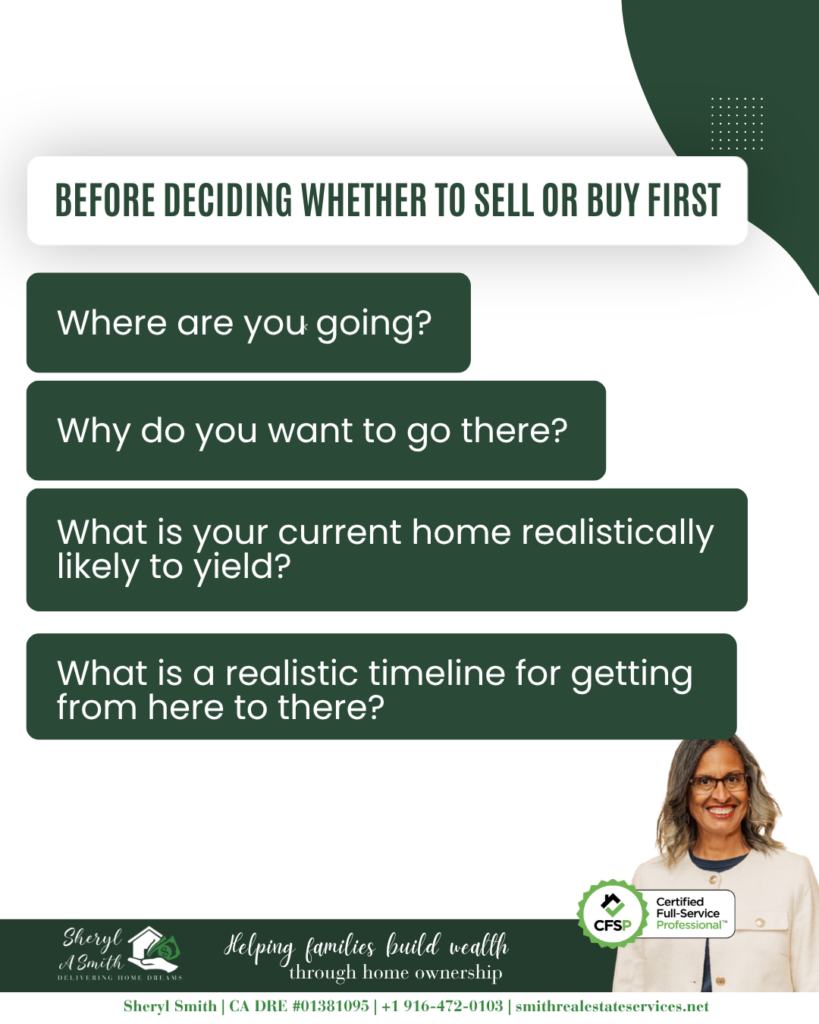
- Where are you going?
- Why do you want to go there?
- What is your current home realistically likely to yield?
- What is a realistic timeline for getting from here to there?
These questions are a starting point. The answers alone don’t determine the strategy.
For my clients, this is where personalized planning begins. We look at their finances, current home, destination, the markets involved, timeline, and tolerance for risk before I recommend a strategy for coordinating the two transactions.
I believe homeowners should have enough information to understand the process before deciding whom to hire. But the detailed strategy I develop for a simultaneous sale and purchase is part of the professional representation I provide to my clients.
That’s important because there isn’t one universally “right” way to sell and buy at the same time.
The strategy comes after I understand the client’s circumstances, not before.
Your Next Home Should Improve Your Life
Nobody goes through the work of moving just for the sake of moving.
The point is to get to your next best place.
Sometimes that means discovering that now is the right time to sell. Sometimes it means adjusting the plan. And occasionally, the smartest conclusion is that your current home still serves you better than the available alternatives.
If you’re considering selling your current home and buying another, you don’t need to have everything figured out before talking with a Realtor.
But before putting either transaction into motion, make sure you’re clear about where you want to go, why the move matters, and whether the financial and market realities can get you there.
That’s when a complicated sell-and-buy transaction can become a well-planned move to what’s next.
Thinking About Selling and Buying at the Same Time?
If your next move depends on selling your current home, the first step isn’t necessarily putting your home on the market or starting to tour houses.
It starts with understanding where you want to go, what your current home may realistically yield, and whether the pieces can work together.
If you’re considering a move in Rancho Cordova, Folsom, or Gold River, I can help you evaluate the sale and purchase together. If your next home is outside my service area, I can also help connect you with a qualified Realtor through my nationwide referral network.
Sheryl A Smith, REALTOR®
CA DRE #01381095
916-472-0103